YOGURT CHEESE (Farmers or Cottage)

Yes it’s already time for another cheese recipe. You’re going to be seeing a lot of them on this blog.  Not only because cheese was a staple of many ancient diets, but also because cheese.

1 qt high quality, non homogenized milk (Goat or cow will work)
1 cup yogurt (or buttermilk or sour cream)
Salt

Day 1
Set up a double boiler. This is just a medium pot half filled with barely simmering water, and a large bowl resting on top.
Whisk  the yogurt or cultured cream in the bowl, then slowly pour in the milk, whisking as you go to fully incorporate.  Stirring every 15-20 minutes, heat the milk until just warm, or 100 Fahrenheit. Turn off the heat and let the bowl sit unstirred a few minutes until it rises about 5-7 degrees.
Wrap in towels and put in a warm place 24 hrs.

Day 2
Put the bowl on the boiler again and repeat as day one only this time do not stir it. Tilt the bowl every 20 minutes to recenter where the heat goes but otherwise leave undisturbed until the temps around the mixture range from 90-115 degrees, or to when curdling just begins but hasn’t set in.

Day 3
Repeat process but on medium heat, tilting the bowl but not stirring until temperatures around the mixture range from 110-135 Fahrenheit.  Take off the heat and stir.
Set four layers of cheese cloth in a colander over a bowl, and add entire mixture to drain.  Scoop out now for “cottage cheese” with lots of whey, or tie off to sink for cream cheese (1-2 hours) or queso fresco (6-8 hours).

Our first recipe was as basic and fast as cheese can be. Today, we’re doing something a little more complex.  Not much more difficult, but definitely much longer.  This recipe takes 3 days total to complete, but only a couple hours of “active” time.

I like to call it Yogurt Cheese, as you’ll soon see why, but it also goes by other names like Farmers cheese or Cottage cheese, maybe because it’s a great use of very fresh milk right off the farm.  As with all our dairy recipes, the quality of your finished product will depend on how good a milk you are using.  Don’t skimp.

Done just right, it is somewhere between spreadable and crumbly, and can be adapted towards either end of the spectrum to suit your preference, depending on how long you hang it to drain at the end.

Top to bottom: 1) Something like cottage cheese from a tub at the store.   2) a spreadable almost cream cheese-esque cheese, and   3) what is essentially like queso fresco. I usually like something between 2 and 3, best of both worlds.

The ingredients and method have stayed simple, and one can easily imagine an ancient herder, whose left his or her yogurt drink in a spot just a little to warm for it, and discovered this fresh cheese. Continue reading “YOGURT CHEESE (Farmers or Cottage)”
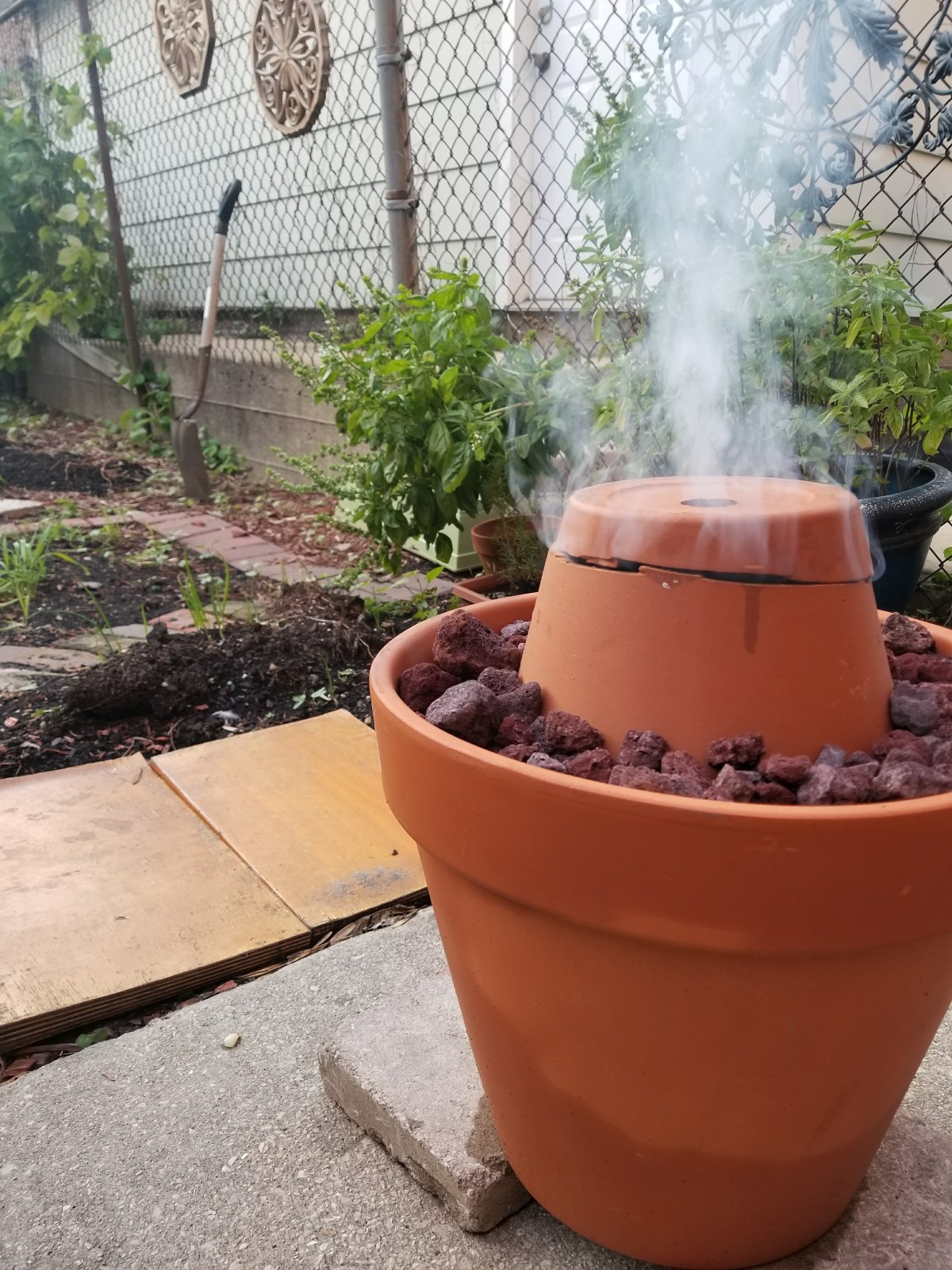
TERRACOTTA TANDOORI OVEN

When people settle down out of forager lifestyles and into Neolithic lives, they always invent pottery technology to help it.  This enables them to store surplus food, and it also enables them to take ovens out of the ground, and one step closer to those we are more familiar with today.


One of these ancient ovens, the Indian Tandoori or just Tandoor, is still popular today.  It’s simple design and somewhat more portable form make it pretty similar to many similar ovens of the era.  And today, we’re going to make our own for less than $100 (If you already own the tools)

Look, this is not at all how an ancient person would have made one of these.  If you have any masonry or pottery skills, as Neolithic peoples did, you can shape and fire your own vessel with an open top out of clay and pure artisanship.

But I’m a cook. Not a potter. I’m going to use power tools. Hey, Neolithic people exploited every resource available to them.  If they had power drills, they would have used them!

Here’s everything you need:

20171018_150416.jpg

Continue reading “TERRACOTTA TANDOORI OVEN”

HOMEMADE BUTTER (the primitive way)

-1 pint heavy cream
-1/2 teaspoon salt
-Quart sized sealable jar

Pour cream into jar, not more than halfway full, and seal.  Shake vigorously for 10-15 minutes (or whip in a stand mixer) until the fat separates and butter is former. Remove butter, pressing out excess buttermilk and rinsing with ice water. Fold in salt, form into shape, and serve immediately (or later if you can stand the wait)


Next week, Episode 2 of the Anthrochef podcast, Gardeners of the Neolithic, will be released.  To learn more about the first villagers and settlers who planted the seeds of modern civilization, you will have to tune in on October 9.

But what I can tell you for now is that this is the era where we see the birth of domestic farm animals, and the beginning of human’s love affair with dairy.  Lactose tolerance is one of very few ways we are NOT identical to ancient humans.  Like most animals, humans used to drink breast milk as babies, then lost the ability to digest dairy as they get older.

But as people began putting pens around wild goats and cattle, and the first herding societies took off around 10,000 years ago, that all began to change.  Genes mutated, human evolution continued, and soon enough, many Neolithic people could drink milk into adulthood, and things would never be the same.

Soon enough, we will be taking on fermented milk (yogurt) and cheese, but today we’re going to keep things more basic, with a simple recipe for milk-fat, aka butter!

20170928_182821.jpg

Butter is just the solid fat of milk separated out.  It was very useful to ancient people because it could be stored long term, a great way to extend the life of very perishable milk. All you need to make it is a jar with a lid, ten minutes, and some muscles.

20170928_180834.jpg

Continue reading “HOMEMADE BUTTER (the primitive way)”

ROASTED MARROW BONES

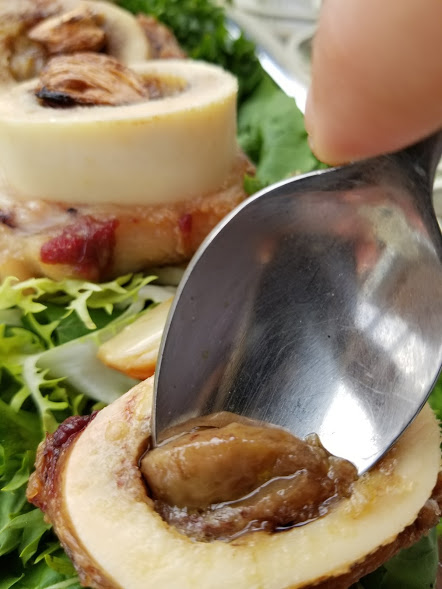
marro1.jpg

Beef Femur bone (kept whole and split length wise, or cut in “rings” as shown here)
2-3  large garlic cloves
Olive oil and salt
Salad or Bread to eat with it (optional)

Preheat oven to 400F. Lay out marrow bones on foiled baking sheet, coating with olive oil and salt to taste. Peel and smash garlic cloves, rubbing them onto marrow and leaving in place for roasting.
Cook in the oven for 15-20 mins, until the marrow is bubbly not so long that it liquefies and falls out of the bone. Let cool 5 minutes, then scoop out and enjoy with bread or salad.

Today we’re talking bone marrow, our last pre-Neolithic inspired recipe for a while before we dive into bread, beer, cheese, and settled life.

marrow2

If you listened to the first episode of the Anthrochef podcast, you know that eating meat played a big role in growing the brains of our earliest ancestors.  Remember though, that we did not start out as hunters, but rather as scavengers.  DNA evidence shows that the earliest humans ate with the dogs and picked clean carcasses some other predator had already killed.

But most of the good meat was already gone by the time these upright apes could get to it. What was left besides a few meager scraps?

Bone marrow, the spongy, flexible interior of most animal bones.   Continue reading “ROASTED MARROW BONES”

FORAGER’S PESTO


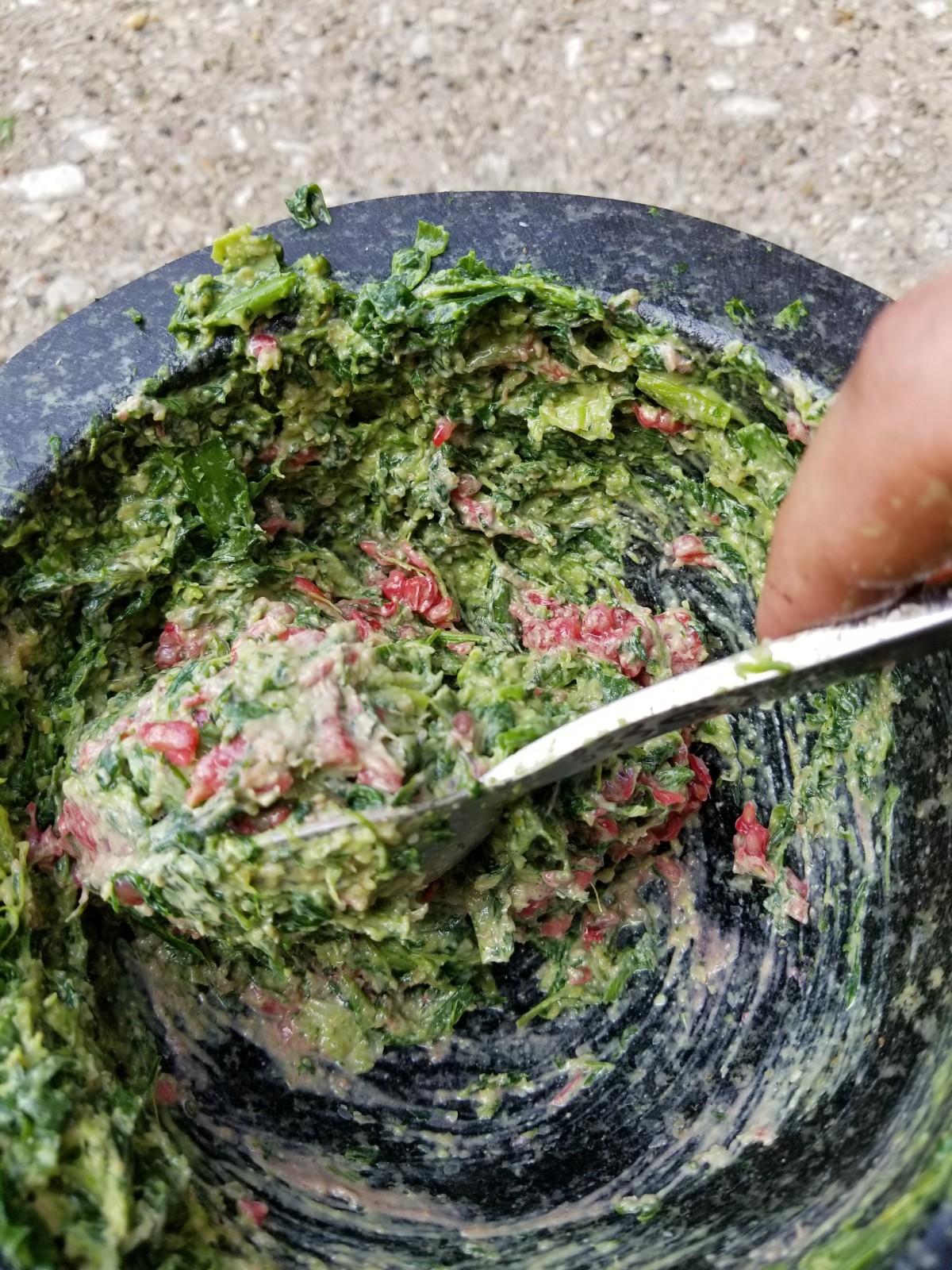
1/4 cup seeds (pictured sesame seeds)
2 tbsp. nuts (pictures pine and walnuts)
2 tbsp. water
1 bunch wild onions (spring onions or scallions work fine)
1 bunch herbs leafy herbs (pictured carrot tops)

5 oz. greens (pictured Arugula)
1/4 cup ripe berries (pictured raspberries)

Before fire, before homo sapiens even, there was a primitive form of cooking that required no heat or fuel but that of the human body.

The oldest known mortar and pestle goes back almost 40,000 years ago, but we know mashing food goes back to some of our earliest human ancestors, who likely smashed bones to access their delicious marrow.  They turned what whole meat they could scavenge into something like steak tartare. This high calorie, high in protein meat played a big role in growing our brains closer to their modern size.

Human foragers of the past had a vast knowledge of plants, animals, and ecology that would put most of us “civilized” people to shame.  Modern foraging people studied by anthropologists are like nature encyclopedias for their territory.

“Wild” greens, onions, and berries from my territory

Continue reading “FORAGER’S PESTO”

MODERN ASH BREAD

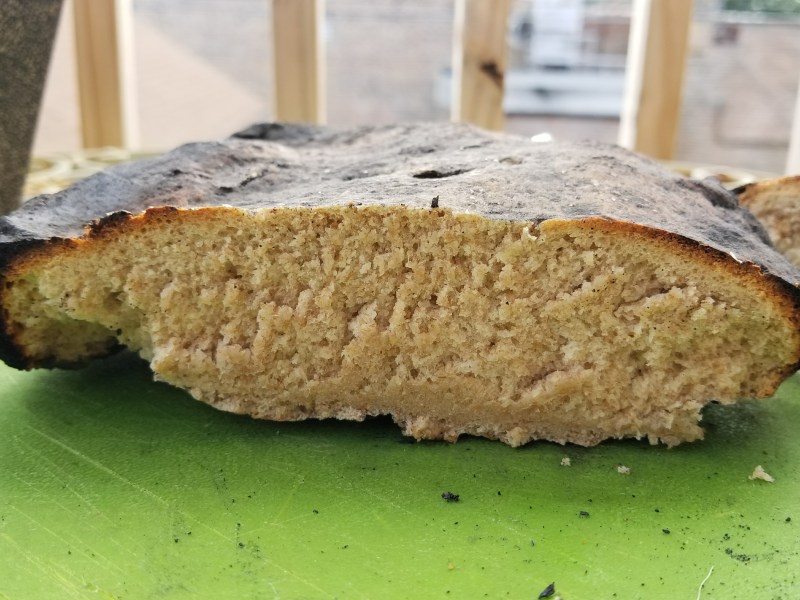
20170817_173951.jpg


300g all purpose flour (about 2.5 cups)
200g whole wheat flour (about 1.5 cups)
1 tbsp salt
1 tbsp dry active yeast
1 tbsp. honey
3 tbsp. olive oil
350ml warm beer or water (scant 1.5 cups)

This recipe takes the ancient cooking technique, and gives to it modern ingredients, making a stretchier dough with a lighter texture that’s more enjoyable to modern palates. All the smoky flavor of the ashes without the  unleavened chewiness of the more authentic recipe.  This is a great flatbread recipe even for a regular oven, but nothing tastes quite like the ash.

Activate the yeast in the water. After five minutes, whisk in the honey, olive oil, and salt.  Add to flour and stir until a rough dough forms.


Continue reading “MODERN ASH BREAD”

HOW TO MAKE ASH BREAD

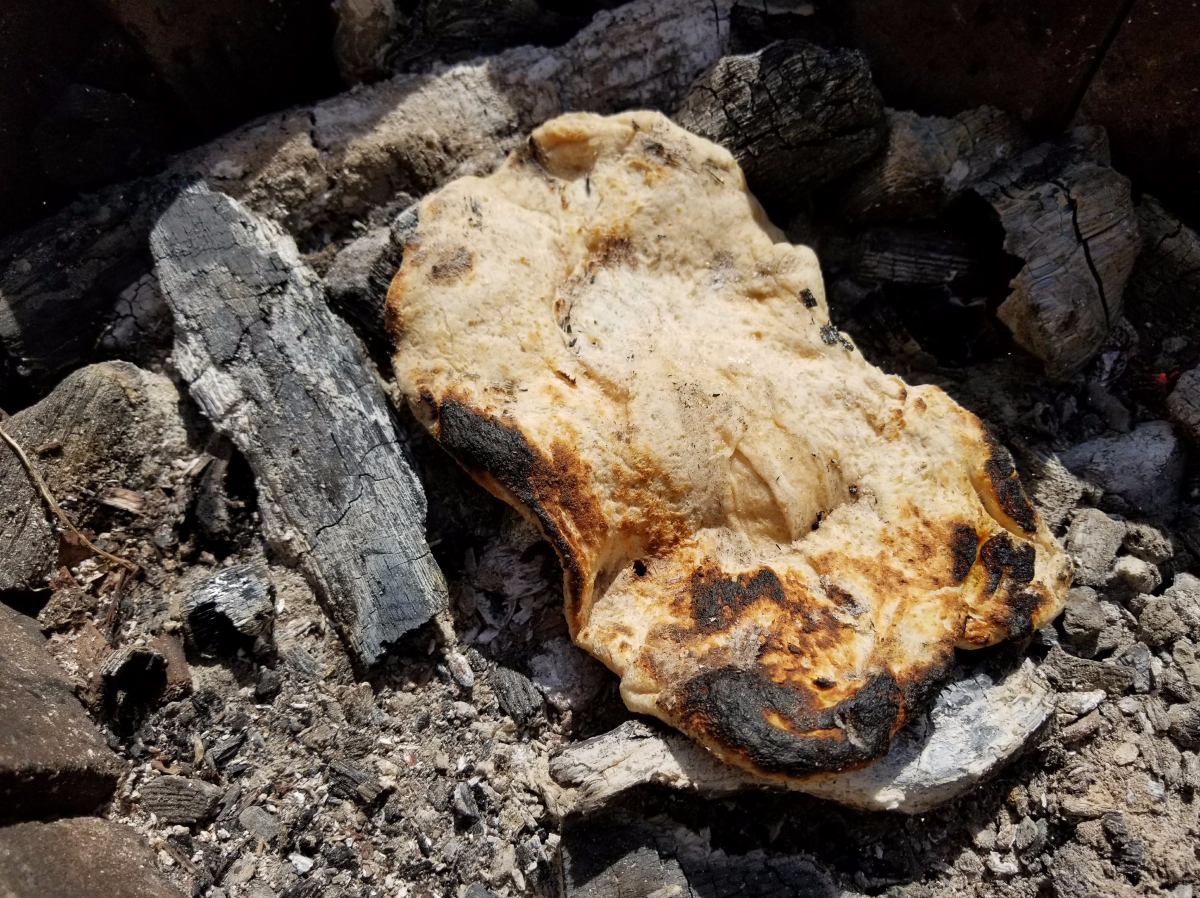
20170817_173909.jpg

Just what it sounds like.  Today I made bread in the ashes of the fire.


This has become known as kind of an Australian food. But that’s because European colonists copied the Aboriginal peoples who had been doing it for thousands of years.

Many modern people with nomadic traditions, such as the Berbers of North Africa, still cook bread this way, but the roots go deep back into prehistory. Evidence for this practice can be found in ancient cultures all over the world from the Americas, to aboriginal Australia, and most famously in the middle east.


Continue reading “HOW TO MAKE ASH BREAD”

HOW TO BUILD AN EARTH OVEN

Short of mashing our food or cooking it over an open fire, the Earth Oven is the oldest cooking method known to humankind.  Evidence of their use goes back tens of thousands of years, and they can be found all over the world across nearly all cultures.

The exact construction can vary, but the basic design is the same. Dig a pit in the ground, line it with stones, get those stones blazing hot, then put some food in and bury it!  This method can bake, smoke, or steam food. It’s not as much work as it seems, and it makes for a exciting cooking experience that’s great for parties and summer barbecues especially.

Not only is it fun, it imparts a unique flavor to the food that’s cooked inside one that can only be described as “earthy” and makes any other food I’ve heard called “earthy” before this seem like a lie.  Soil infused?  This stuff tastes like it was cooked inside the earth, because it was!

If you’re interested in new and interesting ways to cook your food, you cannot beat an Earth Oven.

IMG_20170623_113922520.jpg


Continue reading “HOW TO BUILD AN EARTH OVEN”