Sumerian Onion Bread (for gods or royalty)

No peasant fare today.  This bread is for deities or royalty only.

We know the Sumerians, original urban culture of the world, were obsessed with many types of onions, especially leeks.  We also know that temple priests took great care to prepare special food for their resident god or goddess. Most people used flour that was pretty coarse compared to modern ones, but it’s likely that the finest, and most finely ground, sieved, and combed through flour would go into bread made for Enlil or Inanna, presented by priests at four lavish meals per day, every day.

20180126_125309.jpg

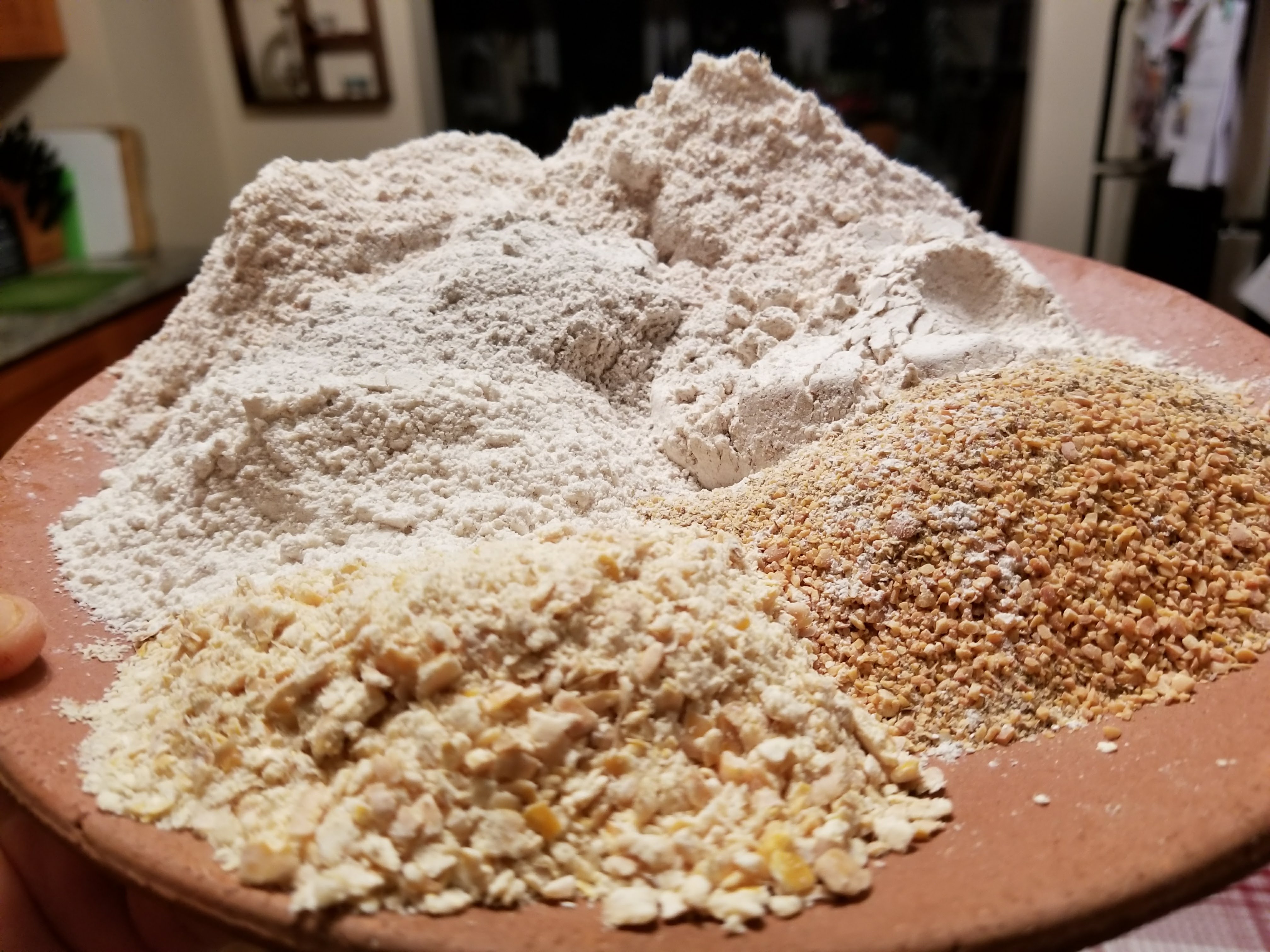
This recipe, which is a modern invention, simulates a bread that was fit for the gods by incorporating all-purpose, wheat, and barley flours together with cooked leeks and green onions.  The technique is similar to how Chinese style scallion pancakes are made, but this bread uses a leavened dough and is cooked in pork fat, as the Sumerians loved to do.

(Makes 6 flatbreads)
1.5 cups all-purpose flour
1 cup barley flour
1/2 cup whole wheat flour
1/2 tablespoon (or 1 packet) of yeast
2 teaspoons salt
1.5 cups warm water
1 bunch leeks, sliced
2 bunches spring onions or scallions, sliced
4 tbsp. butter
3-6 thinly sliced strips pork belly (or bacon)

Start by making the dough. Add the yeast to the warm water and let activate for 5-10 minutes. Meanwhile, mix your flours and salt, then combine into a loose dough. Turn onto a surface coated with flour and knead for 10 minutes, until smooth and stretchable.


Continue reading “Sumerian Onion Bread (for gods or royalty)”

Sumerian Beer

Our first real recipe from history. . . why not for a beverage?

The discovery of beer goes far back into Neolithic times. It’s reasonable to assume that the first beers were made by accident, when porridge or mash from grain malted for other purposes was left too long for whatever reason, and fermented.

Thus by the 2000sBC and the rise of  Mesopotamian civilization, people were already proficient brewers.  Sumerian texts mention eight barley beers, eight emmer beers and three mixed beers (one of which we’ll be making today) This special beverage was made from the same grains which the Sumerians were well aware how important it was to their civilization. As such, brewing was sacred, serious business.

The Hymn to the goddess of brewing Ninkasi, from around 1800BC at the peak of Sumerian culture, not only shows the peoples’ reverence and awe at this fermented beverage, but also contains a recipe for how to make the stuff! Modern brewers have taken the instructions and recreated this ancient recipe for barley and wheat beer, which Cathy K. Kaufman handily publishes in her great book Cooking in Ancient Civilizations.

The basic method is to malt some wheat berries, then soak them with water, yeast, date-syrup, and a par cooked, fermented loaf of barley dough.  The whole process takes about a week and yields a mild, pale brew that’s only 2% alcohol and doesn’t quite taste like what you’re used to in modern beers.

But it’s not unpleasant!  And it does the job. I would compare the flavor more to cider than to beer. Barley cider if you will, but this is a close approximation of the kind of draught which helped build a civilization. Continue reading “Sumerian Beer”

Ancient Honey (date) Mustard

“Mustard is a plant. Mustard is an herb. Mustard is a condiment. Mustard is a sauce. Mustard is a green leafy vegetable. Mustard is a natural medicine.”
—via foodtimeline.org, Oxford Companion to Food, Alan Davidson [Oxford University Press:Oxford] 1999

Mustard is not only my favorite condiment, in all its forms. It is the original condiment. Ground wild mustard seed paste goes back far into prehistory. We can’t even say who or when it was invented.

We do know it was popular with the Sumerians and their descendents, covered in HISTORY OF FOOD EPISODE 4: How to Turn Food into Wealth.  Mustard was used for both its seeds and its leaves, and is referenced in multiple cuneiform texts.

This is my version of a sweet and spicy ancient honey mustard, using dates and their syrup as the sweetener and nothing else but mustard seeds and vinegar.  But you can use any combination of seeds, greens, other spices, herbs, or milk can make your own favorite mustard.

For Pickled Mustard Seeds:
1/2 cup mixed mustard seeds
2 cups vinegar, boiled

Pour the boiling vinegar over the mustard seeds and let sit and room temperature for 24 hours.


For dry mix:
1/2 cup mixed mustard seeds
2 teaspoons salt Continue reading “Ancient Honey (date) Mustard”

HOF Episode 4: How to Turn Food into Wealth (Sumer)

We’ve done it. We’ve finally crossed into the realm of written records and recorded history.  Join me on an odyssey going back 6,000 years ago, when the Sumerians of what is today southern Iraq, took a mega-surplus of grain and transformed it directly into wealth and power.  In the process, they managed to invent cities, urbanism, and all the trappings modern civilization. (Not to mention the first written recipes and cookbooks)

Theme music by the incredible Michael Levy of Ancient Lyre. This rendition of the Hurian Hymn, the oldest known piece of sheet music, and the whole album “An Ancient Lyre” and much more is available from all major digital music stores and streaming sites.

AVAILABLE ON SOUNDCLOUD AND ITUNES.
Please leave a review to help spread the word!

(Fun note: this is the era and society that produced the banner art for this website, a royal banquet in Mesopotamia)

Continue reading “HOF Episode 4: How to Turn Food into Wealth (Sumer)”

Fertile Crescent Multi-grain Bread

When times were tough in the ancient world, those dependent on their primitive farms might have come up short on their preferred grains for bread and would have been forced to add other flours to the mix.  For the vast swath of commoners across ancient Mesopotamia, from modern Iran, Iraq, Syria, Turkey, and Mediterranean coast, this hearty multi-grain bread was actually healthier, though nobody knew it at the time.

This bread is made from grains that could be found all over the middle east in 5000 BC. The cultivated wheat and barley, with lentils and chickpeas from the garden, and spelt and rye foraged in the wilderness around the village.

20171230_174356.jpg

Like NATUFIAN BARLEY BREAD and MODERN ASH BREAD this is another experiment that allows us to really appreciate the miracle of leavened bread. We’re gonna make this two ways, a leavened sourdough loaf with the knowledge of modern cooking technique, and a cracker like version that’s probably more accurate for what an average peasant had to make do with from time to time. Continue reading “Fertile Crescent Multi-grain Bread”

Mesoamerican Blackbean Tamales with Chili Sauce

Spicy. Simple. Delicious.

To accompany the Mesoamerican section of episode 3 of the History of Food, we’re making authentic ancient tamales in the earth oven, just like would have been done in pre-urban Mexico and Guatemala.

These tamales are a little plain, and lack the fat and leavening agents that help make modern tamales so delicious. We’re making ours with only the ingredients the ancient Mesoamericans had, that is with corn, lime, and water.

But that’s okay, we’ve got some other authentic ingredients to help the flavor along.  Black beans for filling, and chili sauce for garnish, and roasted squash as a side are going to give us flavor and depth, even if the tamale itself is bare bones.

Sweetcorn or Popcorn won’t work. You need plain field corn for this, which in some areas can be hard to come by.  You can find it in many Mexican markets, almost any tortilleria, or if you’re truly lucky, a farmer.

For the tamales:
400g Plain Field corn (NOT sweet or popcorn)
6g Cal (pickling lime)
5 cups water
Dried corn husks for wrapping the tamales

For the Black bean filling:
3/4 cup dry black beans

5 cups water
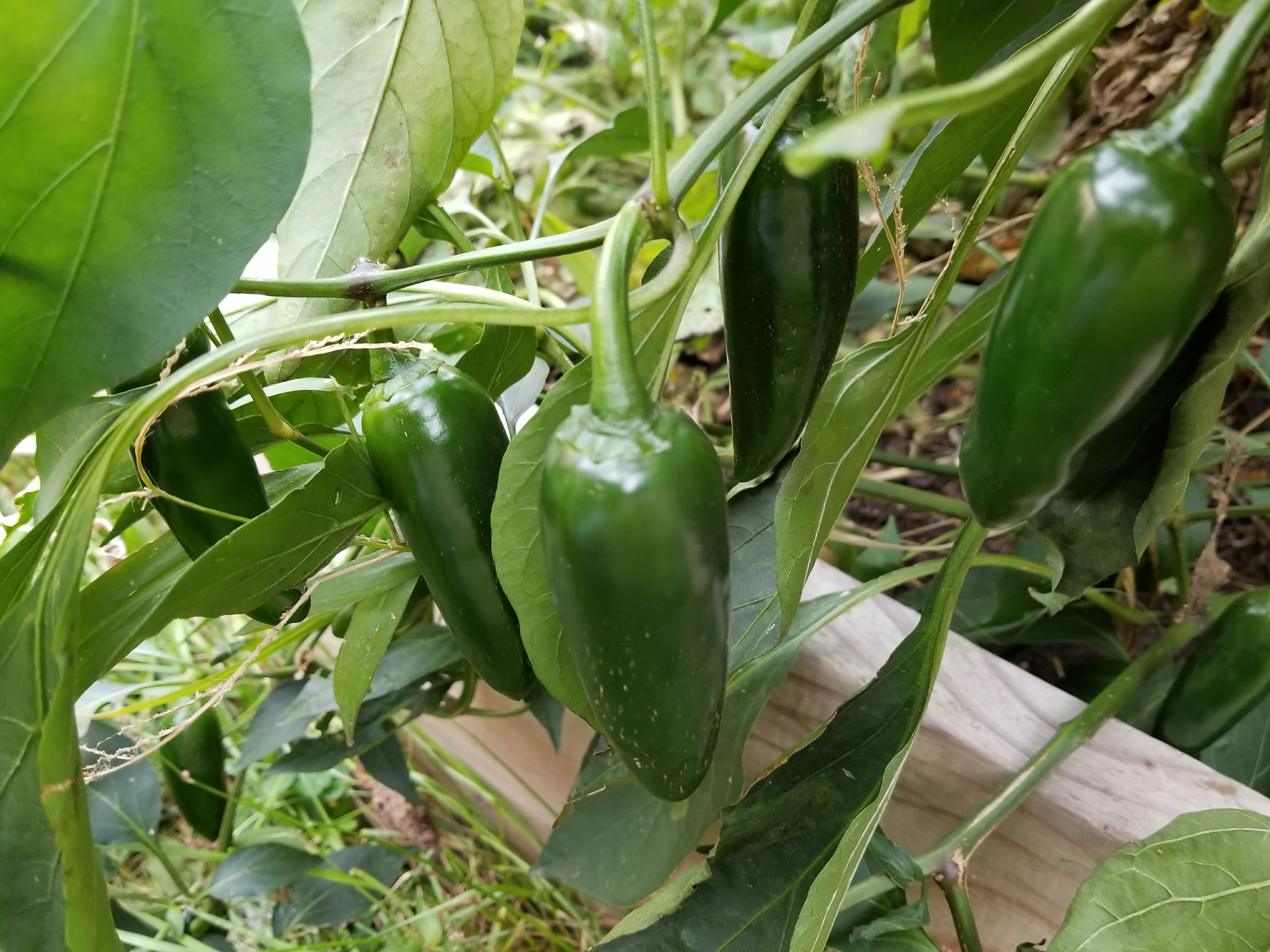
1 fresh chile
1 medium onion

For the Chili sauce:
6-7 fresh chiles
Seeds from 1 squash or pumpkin
water

20171031_095428.jpg
20171031_100404.jpg Continue reading “Mesoamerican Blackbean Tamales with Chili Sauce”

The Best Lentil Soup

Lentil soup has become a punchline, a shorthand meat eaters use to make fun of how boring the vegetarian diet supposedly is.  But this is WRONG! Lentils are amazing, and lentil soup can be one of the most simple and transcendent things you ever cook if you do it right.

The ancients of the Near East sure knew how to use lentils, and other pulses similar to it.  For most of antiquity, lentils were considered a poor man’s food.  Common folk could not usually afford meat, but lentils and chickpeas would have been a great protein substitute.
This supposed peasant food is nutritious, satisfying, and quite packs a lot of flavor with a few simple ingredients. Using modern versions of the ingredients available since the Neolithic on is enough to make a creamy, hearty, and healthy soup.

20171115_141619.jpg

1 cup red lentils (But you can substitute other colors too)
4-5 cups water
1 large onion, diced
1 fat carrot, diced
3-5 cloves fresh garlic, mashed
1/2 cup Tahini water (see recipe)
Crushed coriander, cumin, and mustard seeds (or just use Garam Masala spice)
1 cup Yogurt (leave out for vegan version)
1/2 bunch Coriander (cilantro) or Parsley leaves chopped

(Makes 3-4 bowls)

  1. Coat the bottom of a stockpot with sesame oil (or butter) over medium heat. Add the onion, garlic, and carrot. Season with salt and the ground spices. Saute until the onion is starting to soften, but not fully cooked.
  2. To make tahini water, take an empty Jar of tahini and fill with quarter cup of water, closing and shaking vigorously to clean the jar and make a liquid. (Or simply whisk the water into 2 tablespoons of tahini in a bowl.)
  3. Add the lentils and lightly toast for about 2 minutes. Then add water plus tahini water. Turn up the head to high and bring to a boil.  When boiling, immediately turn down to a simmer.
  4. Simmer for 1-2 hours,  stirring the bottom occasionally. Use the back of your spoon to mash some of the fully cooked lentils against the side of the pot for a creamy consistency.  Add water if desired to adjust consistency.
  5. Mix the chopped herbs and Yogurt together. Add half to the soup and stir in, and reserve the other half for garnish at the end.  Ladle the soup into bowls and then add a dollop of the herb yogurt to serve.

Continue reading “The Best Lentil Soup”

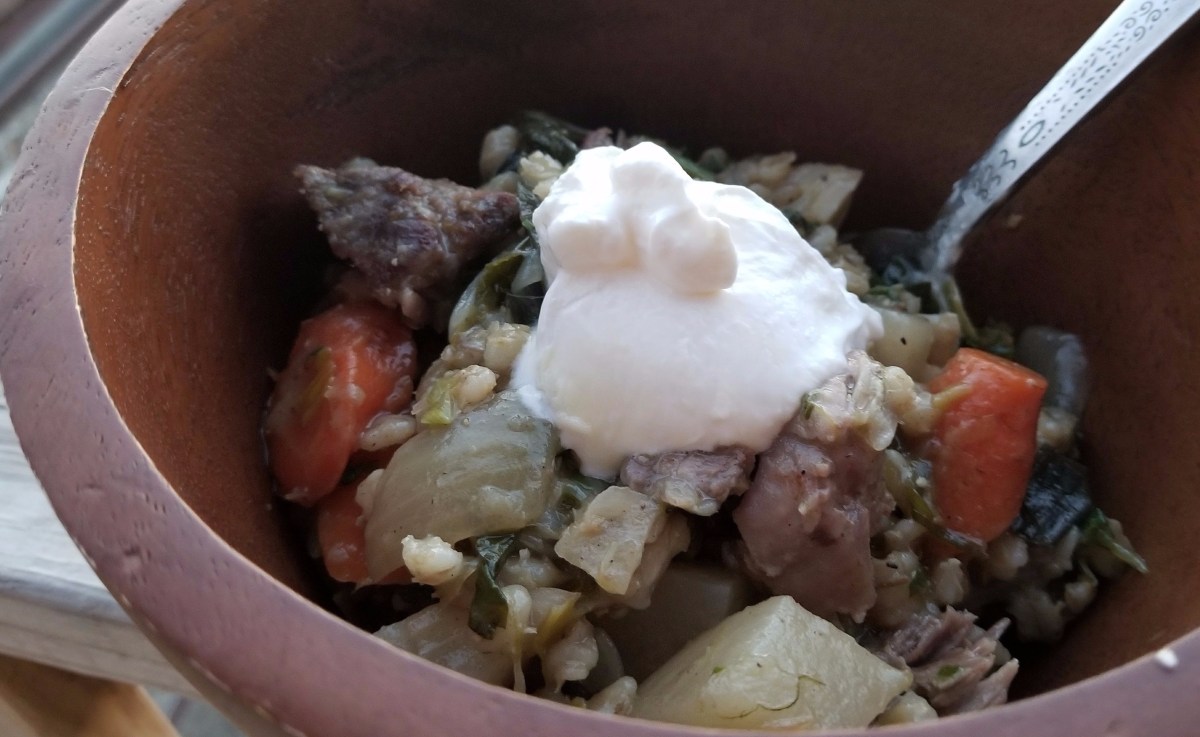
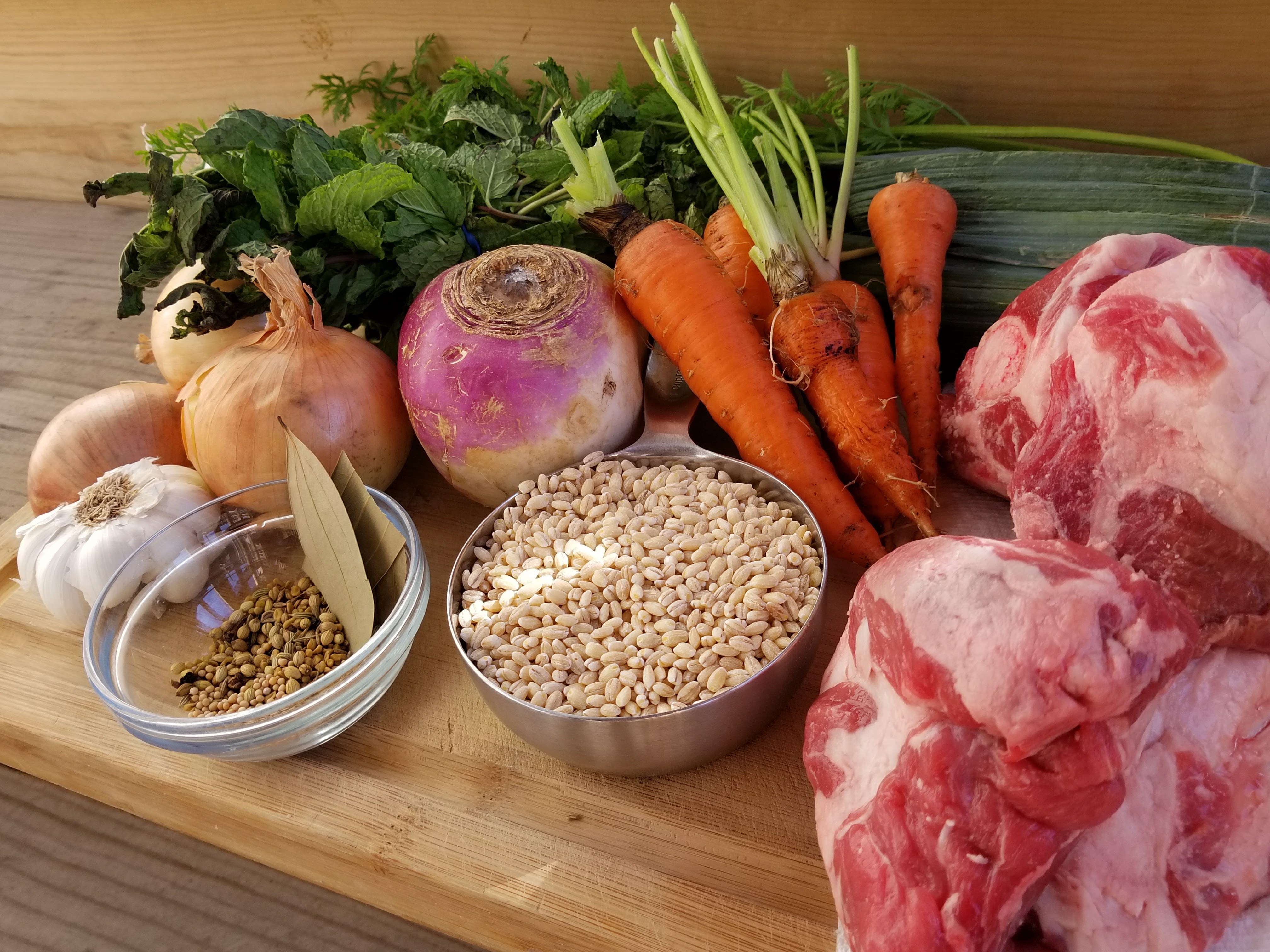
Simple Lamb and Barley Stew

20170928_151325.jpg

Lamb is seared and then cooked with barley and vegetables, that are authentic in name, but are modern and more substantial domestic versions of very different ancient ingredients.

This is a very simple, but delicious dish that means to simulate the kinds of things the earliest farmers along the Euphrates River and the East Mediterranean Coast might have eaten. Continue reading “Simple Lamb and Barley Stew”

YOGURT CHEESE (Farmers or Cottage)

Yes it’s already time for another cheese recipe. You’re going to be seeing a lot of them on this blog.  Not only because cheese was a staple of many ancient diets, but also because cheese.

1 qt high quality, non homogenized milk (Goat or cow will work)
1 cup yogurt (or buttermilk or sour cream)
Salt

Day 1
Set up a double boiler. This is just a medium pot half filled with barely simmering water, and a large bowl resting on top.
Whisk  the yogurt or cultured cream in the bowl, then slowly pour in the milk, whisking as you go to fully incorporate.  Stirring every 15-20 minutes, heat the milk until just warm, or 100 Fahrenheit. Turn off the heat and let the bowl sit unstirred a few minutes until it rises about 5-7 degrees.
Wrap in towels and put in a warm place 24 hrs.

Day 2
Put the bowl on the boiler again and repeat as day one only this time do not stir it. Tilt the bowl every 20 minutes to recenter where the heat goes but otherwise leave undisturbed until the temps around the mixture range from 90-115 degrees, or to when curdling just begins but hasn’t set in.

Day 3
Repeat process but on medium heat, tilting the bowl but not stirring until temperatures around the mixture range from 110-135 Fahrenheit.  Take off the heat and stir.
Set four layers of cheese cloth in a colander over a bowl, and add entire mixture to drain.  Scoop out now for “cottage cheese” with lots of whey, or tie off to sink for cream cheese (1-2 hours) or queso fresco (6-8 hours).

Our first recipe was as basic and fast as cheese can be. Today, we’re doing something a little more complex.  Not much more difficult, but definitely much longer.  This recipe takes 3 days total to complete, but only a couple hours of “active” time.

I like to call it Yogurt Cheese, as you’ll soon see why, but it also goes by other names like Farmers cheese or Cottage cheese, maybe because it’s a great use of very fresh milk right off the farm.  As with all our dairy recipes, the quality of your finished product will depend on how good a milk you are using.  Don’t skimp.

Done just right, it is somewhere between spreadable and crumbly, and can be adapted towards either end of the spectrum to suit your preference, depending on how long you hang it to drain at the end.

Top to bottom: 1) Something like cottage cheese from a tub at the store.   2) a spreadable almost cream cheese-esque cheese, and   3) what is essentially like queso fresco. I usually like something between 2 and 3, best of both worlds.

The ingredients and method have stayed simple, and one can easily imagine an ancient herder, whose left his or her yogurt drink in a spot just a little to warm for it, and discovered this fresh cheese. Continue reading “YOGURT CHEESE (Farmers or Cottage)”

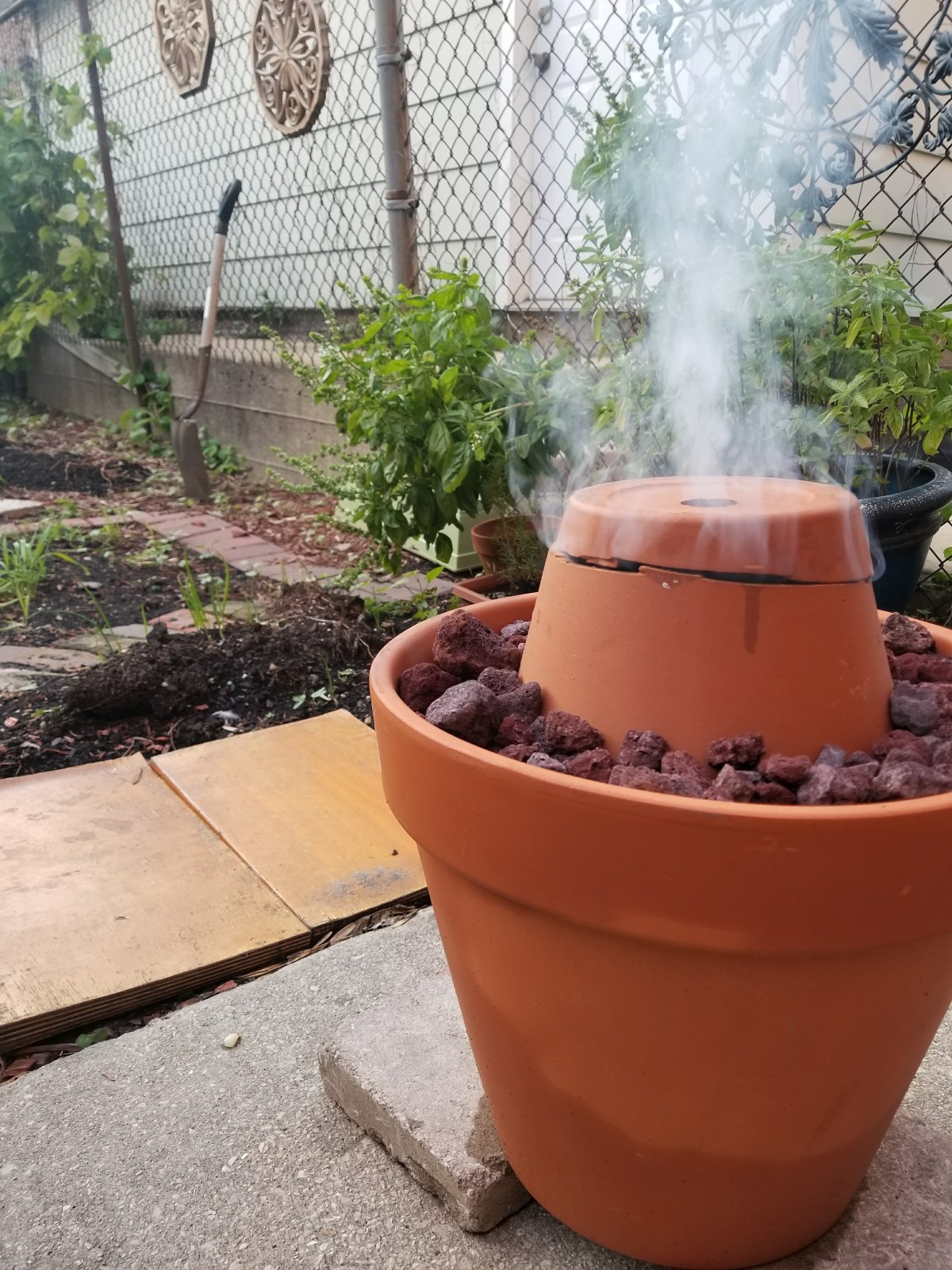
TERRACOTTA TANDOORI OVEN

When people settle down out of forager lifestyles and into Neolithic lives, they always invent pottery technology to help it.  This enables them to store surplus food, and it also enables them to take ovens out of the ground, and one step closer to those we are more familiar with today.


One of these ancient ovens, the Indian Tandoori or just Tandoor, is still popular today.  It’s simple design and somewhat more portable form make it pretty similar to many similar ovens of the era.  And today, we’re going to make our own for less than $100 (If you already own the tools)

Look, this is not at all how an ancient person would have made one of these.  If you have any masonry or pottery skills, as Neolithic peoples did, you can shape and fire your own vessel with an open top out of clay and pure artisanship.

But I’m a cook. Not a potter. I’m going to use power tools. Hey, Neolithic people exploited every resource available to them.  If they had power drills, they would have used them!

Here’s everything you need:

20171018_150416.jpg

Continue reading “TERRACOTTA TANDOORI OVEN”