Greek Cheese, Two Ways

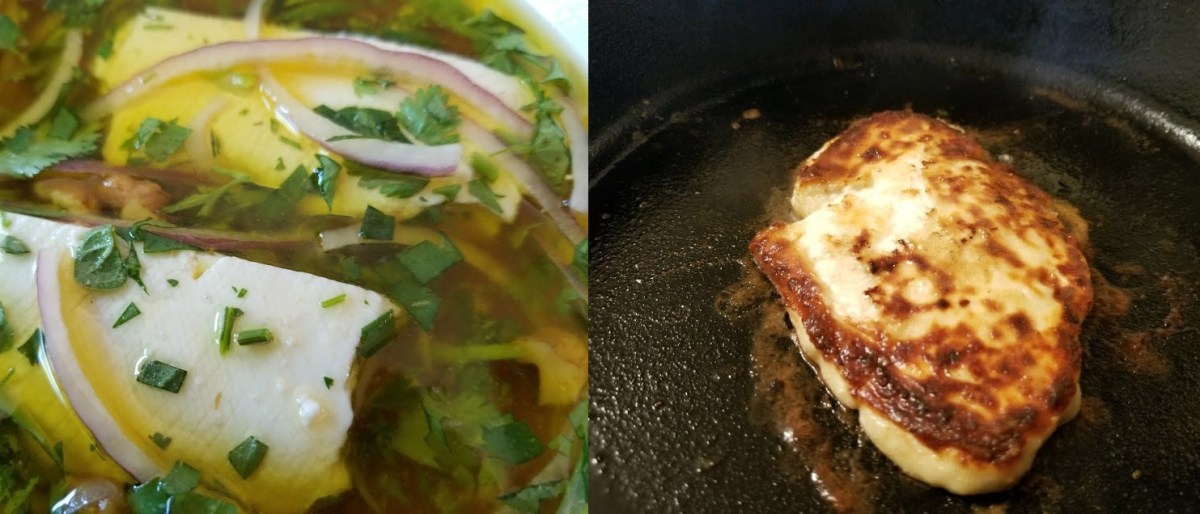
Today, we’re going to use the Homemade Feta Cheese we made last week to prepare two different appetizers.  We know marinated feta, as well as fried cheese are staples in modern Greek food, but probably go back much further into the ancient world.  Greeks have loved their cheese for a long time, especially those who had migrated to Sicily, known for its excellent quality dairy products.

Submerging fresh cheese in olive oil no doubt began as a preservation method, but by adding herbs and aromatics, we can create a really flavorful cheese salad.


As for fried cheese, there are few things far more delicious. Modern Greek restaurants in the US call the dish saganaki, after the name of the frying pan its cooked in.  It’s usually doused in lemon juice and flambeed in distilled alcohol right at the table. “Opa!” shouts the waiter as flames whoosh high up into the air, and the next table says “Oo, I’d like to order that opa thing.”


Without lemon juice or distilled liquor in our Ancient Greek Pantry, we will have to get creative.  Also, we’re using fresh feta cheese. If you want a Saganaki just like you get in a restaurant, substitute Kasseri or Kefalograviera cheese. Continue reading “Greek Cheese, Two Ways”

Homemade Feta Cheese

The first mention in the historical record of cheese aged in brine, known today as “feta”, is in Homer’s Odyssey.  In one of their first adventures after sacking Troy, Odysseus and his men find themselves on the island home of Polyphemus, the cyclops son of Poseidon.  The Mycenaean travelers notice that they aren’t in some typical monster’s lair.  Rather, it’s clear the cyclops is a dairy farmer and cheesemonger, and lives in a full blown cheese cave.

“We entered the cave, but he wasn’t there, only his plump sheep grazed in the meadow. The woven baskets were full of cheese, the folds were full of sheep and goats and all his pots, tubs and churns where he drew the milk, were full of whey. When half of the snow-white milk curdled he collected it put it in the woven baskets and kept the other half in a tub to drink for his supper.”

So while the threat of being devoured remained a threat for Odysseus and his men, Polyphemus is at least civilized enough to pair human flesh with finely brined feta cheese.

20180503_210857.jpg

Making our own just like it is really an easy process, it just takes several days. Continue reading “Homemade Feta Cheese”

Ancient Honey (date) Mustard

“Mustard is a plant. Mustard is an herb. Mustard is a condiment. Mustard is a sauce. Mustard is a green leafy vegetable. Mustard is a natural medicine.”
—via foodtimeline.org, Oxford Companion to Food, Alan Davidson [Oxford University Press:Oxford] 1999

Mustard is not only my favorite condiment, in all its forms. It is the original condiment. Ground wild mustard seed paste goes back far into prehistory. We can’t even say who or when it was invented.

We do know it was popular with the Sumerians and their descendents, covered in HISTORY OF FOOD EPISODE 4: How to Turn Food into Wealth.  Mustard was used for both its seeds and its leaves, and is referenced in multiple cuneiform texts.

This is my version of a sweet and spicy ancient honey mustard, using dates and their syrup as the sweetener and nothing else but mustard seeds and vinegar.  But you can use any combination of seeds, greens, other spices, herbs, or milk can make your own favorite mustard.

For Pickled Mustard Seeds:
1/2 cup mixed mustard seeds
2 cups vinegar, boiled

Pour the boiling vinegar over the mustard seeds and let sit and room temperature for 24 hours.


For dry mix:
1/2 cup mixed mustard seeds
2 teaspoons salt Continue reading “Ancient Honey (date) Mustard”

YOGURT CHEESE (Farmers or Cottage)

Yes it’s already time for another cheese recipe. You’re going to be seeing a lot of them on this blog.  Not only because cheese was a staple of many ancient diets, but also because cheese.

1 qt high quality, non homogenized milk (Goat or cow will work)
1 cup yogurt (or buttermilk or sour cream)
Salt

Day 1
Set up a double boiler. This is just a medium pot half filled with barely simmering water, and a large bowl resting on top.
Whisk  the yogurt or cultured cream in the bowl, then slowly pour in the milk, whisking as you go to fully incorporate.  Stirring every 15-20 minutes, heat the milk until just warm, or 100 Fahrenheit. Turn off the heat and let the bowl sit unstirred a few minutes until it rises about 5-7 degrees.
Wrap in towels and put in a warm place 24 hrs.

Day 2
Put the bowl on the boiler again and repeat as day one only this time do not stir it. Tilt the bowl every 20 minutes to recenter where the heat goes but otherwise leave undisturbed until the temps around the mixture range from 90-115 degrees, or to when curdling just begins but hasn’t set in.

Day 3
Repeat process but on medium heat, tilting the bowl but not stirring until temperatures around the mixture range from 110-135 Fahrenheit.  Take off the heat and stir.
Set four layers of cheese cloth in a colander over a bowl, and add entire mixture to drain.  Scoop out now for “cottage cheese” with lots of whey, or tie off to sink for cream cheese (1-2 hours) or queso fresco (6-8 hours).

Our first recipe was as basic and fast as cheese can be. Today, we’re doing something a little more complex.  Not much more difficult, but definitely much longer.  This recipe takes 3 days total to complete, but only a couple hours of “active” time.

I like to call it Yogurt Cheese, as you’ll soon see why, but it also goes by other names like Farmers cheese or Cottage cheese, maybe because it’s a great use of very fresh milk right off the farm.  As with all our dairy recipes, the quality of your finished product will depend on how good a milk you are using.  Don’t skimp.

Done just right, it is somewhere between spreadable and crumbly, and can be adapted towards either end of the spectrum to suit your preference, depending on how long you hang it to drain at the end.

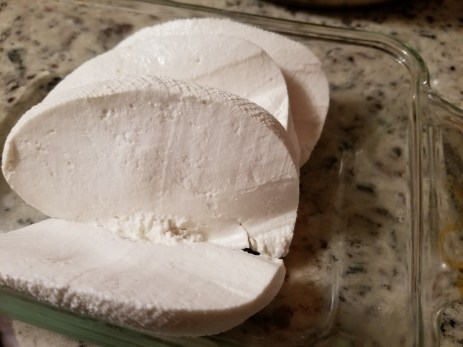
Top to bottom: 1) Something like cottage cheese from a tub at the store.   2) a spreadable almost cream cheese-esque cheese, and   3) what is essentially like queso fresco. I usually like something between 2 and 3, best of both worlds.

The ingredients and method have stayed simple, and one can easily imagine an ancient herder, whose left his or her yogurt drink in a spot just a little to warm for it, and discovered this fresh cheese. Continue reading “YOGURT CHEESE (Farmers or Cottage)”